Education reaches its highest economic impact only when it feeds directly into research, innovation, and the creation of new knowledge. While basic and vocational education raise productivity by improving how existing work is done.

Economic growth is ultimately a story of people, how productively they work, how effectively they adapt to change, and how well institutions enable their capabilities. Over the past five decades, as economies have shifted from manufacturing-led models to knowledge-intensive systems, education has moved from the margins of economic policy to its very core.
Yet, despite this recognition, the relationship between education spending and GDP growth is often misunderstood, oversimplified, or reduced to headline percentages.
This article examines that relationship carefully and empirically. It looks at education investment and economic development through global evidence, India-specific data, and institutional realities.
The central finding is clear: education spending does contribute significantly to national GDP growth, but the strength of this contribution depends far more on how money is spent than how much is spent. Quality, relevance, timing, and governance mediate outcomes.
India today stands at a critical economic juncture. With aspirations of becoming a multi-trillion-dollar economy and with one of the world’s youngest populations, the country has invested substantially in education.
Public education expenditure in India now ranges between 4.1% and 4.6% of GDP, higher than many peers. Yet the economic returns remain uneven. Graduate employability, skill mismatches, and weak research output threaten to dilute the demographic dividend.
What follows is a structured, data-centric examination of why this happens, and what must change if education is to fully translate into sustained GDP growth.
Education Spending and GDP Growth
The first misconception we must address is that education spending and GDP growth move in a straight line. Global evidence does not support this. Instead, the relationship follows a non-linear, S-shaped curve.
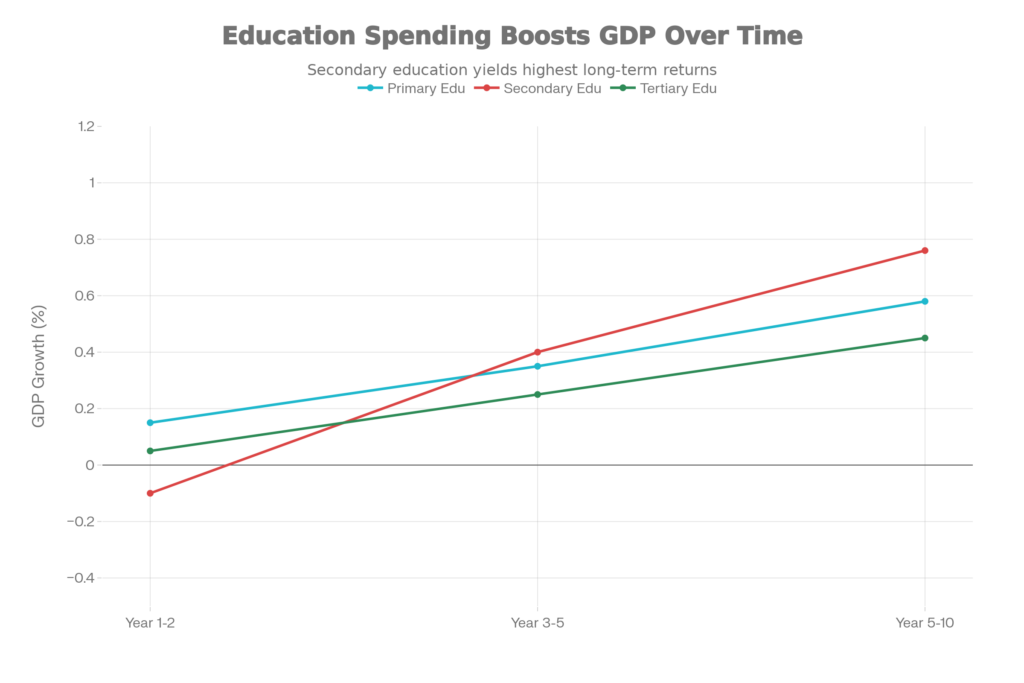
At low levels of development, investments in basic education yield very high economic returns. World Bank estimates show that universal primary education can raise long-term GDP growth by 1–2 percentage points annually in low-income economies. Literacy alone enables labour mobility, formal employment, and productivity gains. India largely completed this phase by the early 2000s.
In middle-income economies, returns begin to plateau unless spending quality improves. OECD data indicates that countries spending between 4–5% of GDP on education experience vastly different growth outcomes depending on how funds are allocated. Merely increasing enrolment, especially in general higher education, produces diminishing returns when labour markets cannot absorb graduates productively.
At advanced stages, growth accelerates again only when education spending is linked to research, innovation, and high-skill ecosystems. South Korea’s experience illustrates this clearly.
Between 1970 and 1990, as it transitioned from light manufacturing to electronics and semiconductors, Korea increased secondary and tertiary education spending strategically. GDP per capita rose from $280 to over $6,500 during that period.
India today sits in the middle segment of this curve. While public education expenditure India-wide is significant in aggregate, marginal GDP gains from additional spending are weakening due to misalignment with the economic structure. Without improvements in quality, employability, and innovation, increased spending risks becoming fiscally inefficient.
The lesson is simple but often ignored: education investment must evolve with economic structure, or its contribution to GDP growth stagnates.
India’s Quantity, Quality Paradox in Education Investment
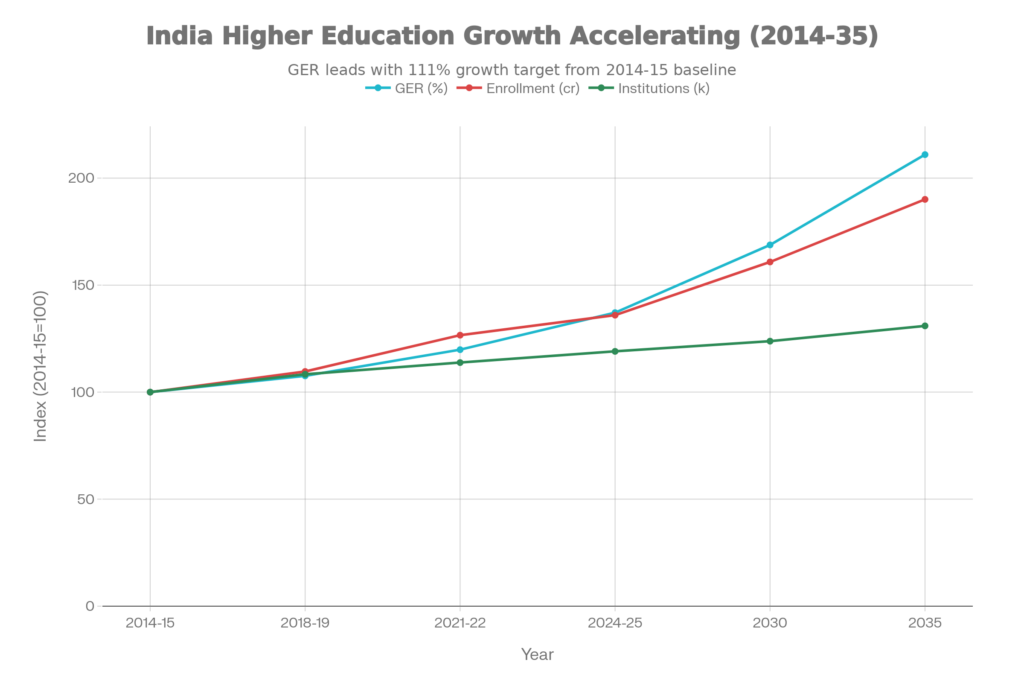
India’s education system presents a striking paradox. On the one hand, scale has expanded rapidly. India now has over 1,100 universities, more than 45,000 colleges, and nearly 40 million students in higher education. The Gross Enrolment Ratio has risen from 23.7% in 2014–15 to 28.4% in recent years.

On the other hand, economic outcomes lag behind this expansion. According to the India Skills Report 2025, only 42–51% of graduates are employable. Over 53% of graduates work in roles below their qualification level, indicating systemic underutilisation of human capital.
This disconnect weakens the returns to education on GDP. Education increases private earnings; graduates earn roughly 2–2.5 times more than non-graduates, but the macroeconomic productivity gains remain muted when skills do not match job requirements.
Public education expenditure in India allocates heavily toward salaries and administration. In many states, over 80% of education budgets are consumed by committed expenditures, leaving little room for curriculum reform, faculty development, industry partnerships, or research infrastructure.
International comparisons are instructive. Finland spends less per student than the United States but achieves superior learning outcomes and higher labour productivity because of teacher autonomy and rigorous preparation. Singapore spends just 3–4% of GDP on education, yet consistently ranks among the world’s most competitive economies.
India’s challenge, therefore, is not insufficient spending alone. It is allocative inefficiency, expanding access faster than quality, relevance, and institutional capacity. Without correcting this imbalance, education investment risks inflating credentials rather than generating economic growth.
Human Capital Without Absorption
Education contributes to GDP growth only when economies can absorb educated workers productively. This concept, often overlooked, is known as absorption capacity.

India produces nearly 10 million graduates annually, but formal job creation lags far behind. The Periodic Labour Force Survey shows that only around 25% of the workforce is formally employed, despite rising educational attainment. As a result, educated youth increasingly enter informal or low-productivity roles.
This mismatch erodes the economic impact of higher education. Employers report persistent skill gaps in communication, analytical thinking, digital literacy, and applied problem-solving. Simultaneously, many sectors, including manufacturing, healthcare, and logistics, face shortages of technically trained workers.
Empirical studies suggest that when absorption capacity is weak, each additional year of schooling adds far less to GDP than expected. In contrast, countries that synchronized education expansion with industrial policy, South Korea, Taiwan, and Vietnam, avoided this trap.
India’s situation is not a failure of aspiration, but of coordination. Education policy, industrial policy, and labour market regulation operate in silos. Universities expand seats without visibility into employment pathways. Employers invest heavily in post-recruitment training, effectively duplicating education costs.
Unless absorption capacity improves, through MSME productivity, manufacturing growth, and service-sector sophistication, the returns to education on GDP will remain constrained, regardless of spending levels.
Time Lags and the Political Economy of Education Spending
One of the most underappreciated aspects of education investment is the time lag. Education spending does not yield immediate GDP returns. Evidence from OECD and Asian economies shows that measurable growth effects often emerge 5–10 years after investment, sometimes longer.
This creates a structural political problem. Governments incur fiscal costs today, but economic credit accrues to future administrations. As a result, education often loses out to infrastructure or subsidy spending with quicker visible outcomes.
Studies from Eastern Europe and Latin America further show that where governance is weak, increased education spending may not correlate with GDP growth at all. Corruption, inefficiency, and poor implementation break the causal chain.
India is not immune. Frequent policy shifts, fragmented governance between the Centre and States, and delayed fund releases dilute the impact. Despite rising allocations, outcomes lag because investments lack continuity.
If education is to function as long-term economic infrastructure, it must be insulated from short-term political cycles. Countries that succeeded created stable funding frameworks, empowered institutions, and accepted delayed returns. Without addressing this time-lag reality, debates on education spending will remain superficial, and GDP outcomes disappointing.
Teacher Quality as a Driver of Economic Productivity
Global evidence is unequivocal: teacher quality is the single most important school-level determinant of learning outcomes, and therefore of long-term economic productivity.

OECD research shows that improving teacher effectiveness by one standard deviation can raise student lifetime earnings by 10–15%, with substantial GDP implications at scale. Singapore’s approach illustrates this well. Teachers are recruited from the top third of graduates, trained intensively, and paid competitively. The result is high learning outcomes at moderate spending levels.
In India, while teacher numbers have increased, teacher preparation and continuous professional development remain weak. Large portions of public education expenditure in India are devoted to salaries without commensurate investment in capability building.
This limits the economic return on education investment. Buildings and technology cannot compensate for weak pedagogy. Without skilled teachers, additional spending produces diminishing returns.
Reframing teachers as economic assets rather than administrative costs is essential. Investments in teacher quality yield some of the highest returns to education on GDP, but only if pursued systematically.
Vocational Education and the Missing Middle of Growth
One of the least acknowledged constraints on India’s economic growth is the weak position of vocational education within the broader education system.

While policy debates often focus on expanding universities and increasing higher education enrolment, the critical “middle layer” of skills, technicians, supervisors, machinists, healthcare assistants, and digital operators remains severely underdeveloped. This gap has direct implications for productivity, industrial competitiveness, and GDP growth.
Globally, countries that industrialised rapidly invested heavily in vocational and technical education at the secondary and post-secondary levels. Germany’s dual education system and South Korea’s technical institutes ensured a steady supply of job-ready workers aligned with evolving industrial demand. As a result, manufacturing productivity rose in tandem with skill supply, preventing large-scale graduate unemployment and underemployment.
India presents a stark contrast. Less than 5% of the workforce has received formal vocational training, compared to over 70% in many advanced economies.
Despite this, labour market data shows that workers with certified vocational skills earn 20–30% higher wages and experience faster employment transitions than their non-certified peers. This indicates that the economic returns to vocational education are both immediate and substantial.
The Skill India Mission has demonstrated this potential, particularly through certification and Recognition of Prior Learning (RPL) initiatives. However, vocational education continues to be treated as a parallel, second-choice pathway rather than an integral part of mainstream education. Social stigma, weak industry linkages, and fragmented governance limit its scale and impact.
For education investment to translate meaningfully into GDP growth, vocational education must move from the margins to the centre of India’s human capital strategy. Integrating vocational pathways within schools, colleges, and universities is essential to strengthening the missing middle of growth.
EdTech as an Economic Multiplier
Let me speak about technology in education with some caution, because EdTech is often presented either as a miracle solution or dismissed as a temporary disruption.

The reality lies somewhere in between. When deployed thoughtfully, education technology can act as a powerful economic multiplier, amplifying the impact of public education expenditure rather than replacing it.
India today hosts one of the world’s largest EdTech ecosystems. The sector was valued at approximately $7–8 billion in 2024 and is projected to grow to $25–30 billion by 2030, with India emerging as a global hub for digital learning products and services. This growth matters economically for two reasons.
First, EdTech reduces the unit cost of skill creation by allowing high-quality instructional content to reach millions without proportional increases in physical infrastructure. Second, it creates a new category of knowledge-sector employment, instructional designers, curriculum architects, AI engineers, content creators, and academic mentors.
From a GDP perspective, this matters because productivity gains in education compound across sectors. Digital platforms enable continuous reskilling, which is essential in an economy where job roles are changing faster than traditional curricula can adapt.
Studies show that digitally enabled training can reduce reskilling costs by 30–50%, making workforce adaptation economically viable at scale. This directly strengthens the link between education investment and economic development.
However, EdTech’s multiplier effect is not automatic. It depends critically on digital infrastructure and equitable access. Nearly one-third of Indian households still lack reliable internet connectivity. Without addressing this gap, EdTech risks increasing learning inequality, which in turn weakens aggregate productivity and limits GDP impact.
Public policy must therefore treat EdTech as complementary economic infrastructure, aligned with public education systems, quality standards, and labour market needs.
When integrated with teacher capacity building and vocational pathways, EdTech can significantly enhance the returns to education on GDP. When left unregulated or disconnected from public systems, it remains a missed economic opportunity rather than a multiplier.
Research, Innovation, and the Upper Bound of Growth
Education reaches its highest economic impact only when it feeds directly into research, innovation, and the creation of new knowledge. While basic and vocational education raise productivity by improving how existing work is done, research-led higher education determines the upper bound of long-term GDP growth by expanding what an economy is capable of producing in the first place.

Global data illustrates this clearly. High-income economies consistently invest 2–3.5% of GDP in research and development (R&D). The United States spends about 3.4%, South Korea over 4.8%, and China approximately 2.4%.
These investments translate into high patent intensity, technological leadership, and sustained productivity gains. In contrast, India’s gross expenditure on R&D has remained around 0.7% of GDP for over a decade, placing a structural ceiling on the economic returns of its expanding higher education system.
Yet India’s performance is paradoxical. Despite low R&D spending, the country ranks 39th in the Global Innovation Index, consistently outperforming its income level. This suggests strong underlying human capital efficiency; Indian researchers and institutions generate relatively high outputs per rupee spent. However, it also signals underutilised potential.
With greater and more stable investment, returns could scale disproportionately. The economic impact of higher education weakens when universities function largely as teaching institutions with limited research depth.
Research investment is what converts education into innovation, entrepreneurship, and industrial competitiveness, the core drivers of high-value GDP growth. Without it, graduate expansion fuels services growth but leaves manufacturing, deep technology, and scientific leadership underdeveloped.
For India, raising R&D expenditure to even 1.5–2% of GDP would significantly amplify the returns to education on GDP, enabling the transition from skill-based growth to innovation-led economic development.
To Conclude
Let me conclude with a simple but firm proposition.
Education spending does matter. The correlation between education spending and GDP growth is real, robust, and supported by decades of evidence. But money alone does not create growth. Quality, alignment, and institutional maturity do.
India has reached a point where expanding access further without reforming quality, relevance, and absorption capacity will yield diminishing economic returns. The demographic dividend is not automatic. Without employability and innovation, it risks becoming a demographic burden.
The way forward is clear. India must shift from expenditure targets to strategic education investment, prioritising teacher quality, vocational integration, research intensity, and labour market alignment. Education policy must be treated as economic policy, not social welfare.
If we get this right, education will remain India’s strongest lever for long-term prosperity. If we do not, no amount of GDP arithmetic will compensate.
The choice, quietly but decisively, is being made in our classrooms today.